
Community Considerations for Data Center Siting
Planning questions Florida local governments can use to evaluate proposals
Updated August 17, 2026
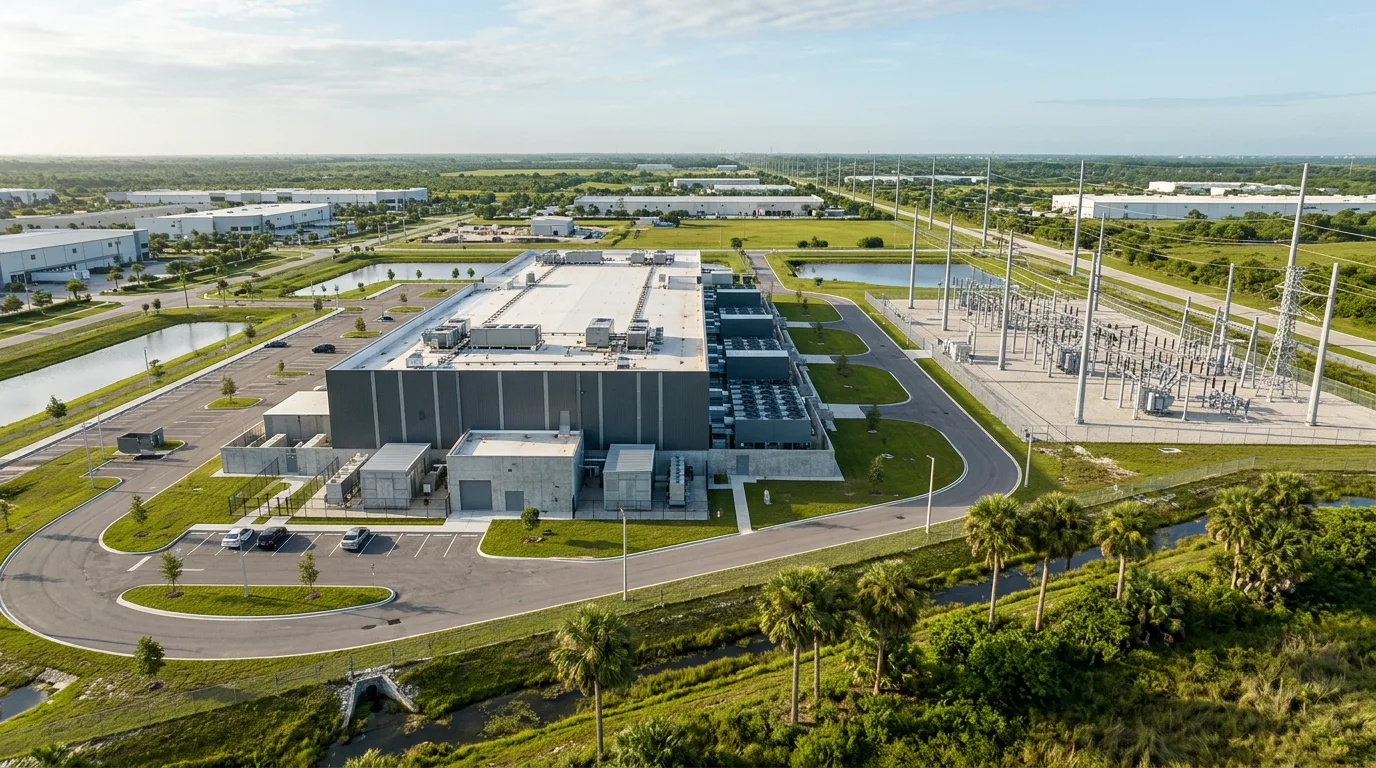
Communities across the country have taken different approaches to reviewing data center proposals. The considerations below are drawn from published local government practices and are offered as a planning reference, organized around five recurring areas of local interest: land use readiness, power coordination, water stewardship, noise and environmental controls, and site design.
Land use readiness
- Confirm that the comprehensive plan and zoning ordinance are current and aligned with each other, and that both speak clearly to large-load or high-intensity industrial uses.
- Decide whether data centers should be a permitted use, a conditional use requiring governing body approval, or excluded from certain zoning districts. Several jurisdictions have moved data centers out of by-right approval and into a discretionary review process.
- Establish a standard information request for applicants covering power demand, water demand, cooling method, generator type, noise projections and site design, so review is consistent across projects.
Power coordination
- Ask the applicant and serving utility to jointly document the facility's maximum requested power draw and how it will be delivered, including any new transmission lines or substations.
- Consider whether new or expanded substations should go through their own siting and approval process rather than being treated as an accessory use automatically approved alongside the facility.
- For backup power, ask what generation and storage technologies are proposed and how long they can sustain critical load. Storage duration and chemistry vary by project and should be documented rather than assumed.
In Florida, SB 484 (2026) directs public utilities to file large-load tariffs with the Public Service Commission by October 1, 2026, which will shape how power costs and delivery obligations for large users like data centers are structured going forward.
Water stewardship
- Request that the facility and the water utility jointly document projected annual water use in writing before approval.
- Ask whether the facility will rely on air cooling, closed loop water cooling or open loop water cooling, since each carries a different water demand profile.
- Ask whether the facility will use potable water or reclaimed water, and whether the local wastewater system has capacity to treat what the facility discharges.
In Florida, large-scale data centers seeking to withdraw water above regulatory thresholds go through a consumptive use permit (CUP) process under chapter 373, Florida Statutes, administered by the state's water management districts. SB 484 adds data center-specific CUP procedures and allows districts to condition approval on reclaimed water use.
Noise and environmental controls
- Consider requiring a pre-construction and post-construction noise study, since actual operating noise can differ from projections.
- Evaluate noise using both standard A-weighted (dBA) measurements and, where feasible, C-weighted (dBC) measurements, which can better capture low-frequency tonal hum from mechanical equipment.
- For backup generators, ask what emissions control technology is proposed and how it compares to applicable state and federal air permitting standards.
Site design
- Address building height and floor area ratio in the zoning ordinance so new facilities are compatible with the scale of surrounding development.
- Consider requiring landscaped buffers, berms or architectural treatment on street-facing facades to soften the visual footprint of large industrial-scale buildings.
- Ask whether onsite microgrid elements, such as backup generation paired with storage, are planned, and how they factor into the facility's overall power and reliability strategy.
This is a planning reference, not a model ordinance. Specific standards should be set locally based on community input and site conditions, and verified against current, jurisdiction-specific data before adoption.
FDISA materials are provided for general informational and educational purposes only and do not constitute legal, tax, engineering, environmental, energy, regulatory, or other professional advice.