
Data Centers in Florida
A plain-language primer for local officials and residents
Updated August 17, 2026
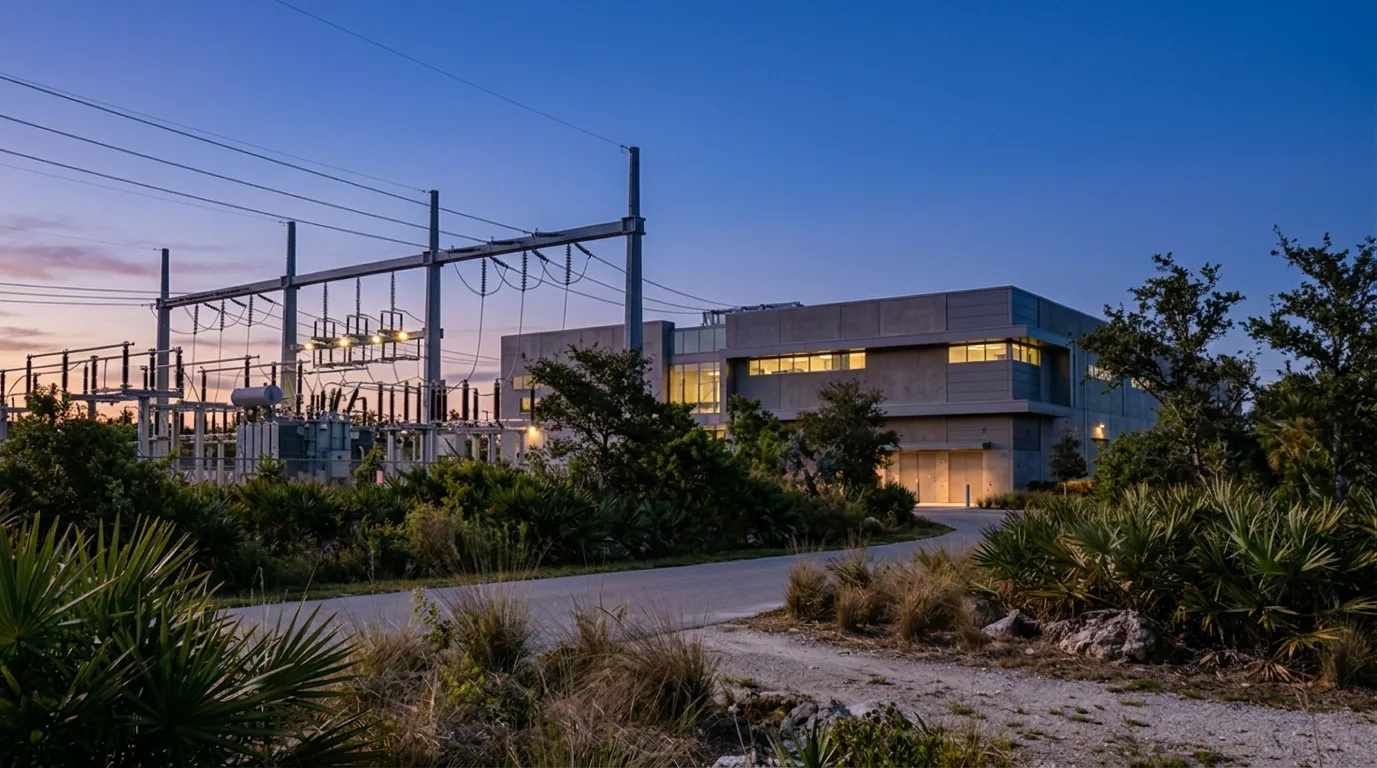
Data Centers in Florida
A plain-language primer for local officials and residents
What is a data center?
A data center is a building that houses computer servers, storage systems and networking equipment used to run websites, mobile apps, cloud services and artificial intelligence tools. Facilities range widely in size, from a single server room to a large campus with multiple buildings on hundreds of acres. Most large facilities require significant electric power and cooling capacity, along with fiber connectivity, backup generators and security infrastructure. Because of these requirements, siting decisions typically involve land use planning, utility coordination and, in Florida, water permitting review.
Senate Bill 484: what the law does
SB 484 took effect July 1, 2026, with select provisions on a different timeline. It confirms that local governments retain authority over comprehensive planning and land development decisions affecting large electricity users, including data centers.
- Ratepayer protection: requires each public utility to file a tariff with the Florida Public Service Commission by October 1, 2026, addressing how large-load customers are billed, with the stated goal of keeping data center power costs from shifting onto residential and small business ratepayers.
- Water permitting: creates a distinct consumptive use permit (CUP) pathway for large-scale data centers under chapter 373, Florida Statutes, and allows regulators to require reclaimed water as a permit condition.
- Independent study: directs OPPAGA, the Office of Program Policy Analysis and Government Accountability, to contract for a study of data center impacts on economic development, tax revenue, natural resources, energy costs and public health and safety.
Note: the ratepayer tariff process is not complete until the PSC reviews utility filings due October 1, 2026. Until then, those provisions are enacted but not yet fully implemented.
Chapter 373: Florida's water law
Chapter 373, Florida Statutes, is the Florida Water Resources Act, enacted in 1972. It gives the state's water management districts and the Department of Environmental Protection authority to regulate consumptive use, meaning any withdrawal that reduces the supply of a groundwater or surface water source.
- Consumptive use permits (CUPs) are required before a facility, including a data center, may withdraw water above certain thresholds, and applicants must show the use is reasonable, beneficial and consistent with the public interest.
- SB 484 adds data center-specific CUP procedures, including treating certain permit modifications as new initial applications and authorizing reclaimed water conditions. Permit review occurs at the water management district level, not the local government level.
Closed loop versus open loop cooling
Data centers generate heat and require cooling to keep servers within safe operating temperatures. The method a facility chooses affects how much water it withdraws and discharges.
- Closed loop systems recirculate the same water or refrigerant through a sealed system, needing only periodic makeup water. Water consumption is generally lower than open loop systems.
- Open loop systems draw water from a source, pass it through once, then discharge or return it, often at a higher temperature. These systems can support high cooling loads but typically require larger permitted withdrawals.
- Hybrid systems: Some facilities use air-cooled or hybrid systems that reduce or eliminate cooling water use, trading it for higher electricity consumption.
Setbacks and noise abatement
Setbacks are the minimum required distance between a facility and a property line, road or neighboring use. Noise abatement refers to measures that limit sound reaching adjacent properties.
- Setback requirements are set locally through zoning. Larger setbacks generally reduce noise, visual and lighting impacts on neighboring properties, particularly residential areas.
- Noise comes mainly from cooling equipment and generators, measured in decibels (dBA); some communities also track dBC readings, which can capture low-frequency tonal hum dBA may miss.
- Common abatement tools include acoustic barriers, berms and pre/post-construction noise studies.
Sources: SB 484 (2026), ch. 2026-65, Laws of Fla.; ch. 373, Fla. Stat.; Fla. Senate bill analysis, SB 484 (2026).
FDISA materials are provided for general informational and educational purposes only and do not constitute legal, tax, engineering, environmental, energy, regulatory, or other professional advice.