
News
The money stays home: What the TaxWatch report says about data centers and local tax bases
October 13, 2026 · FDISA
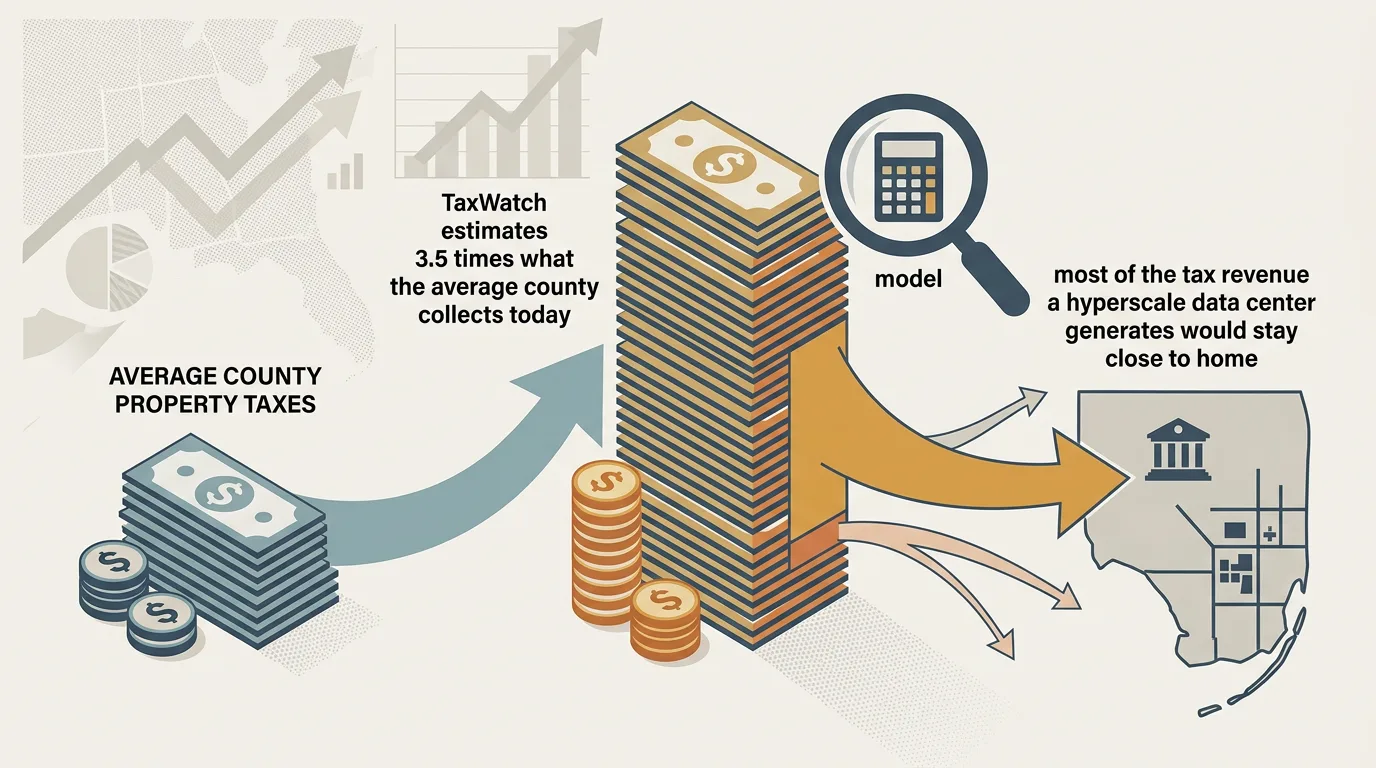
Liberty County collected $6.1 million in property taxes last year. Putnam County collected $142.3 million. Across Florida's 29 fiscally constrained counties, the average was $40.8 million.
Now consider the scale of a hyperscale data center.
Florida TaxWatch estimates that the hypothetical $10 billion, 500-megawatt facility it modeled could generate about $148 million a year in property taxes for the average fiscally constrained county. That is more than 3.5 times what the average county collects today.
And that is only one piece of a larger finding: In TaxWatch's model, most of the tax revenue a hyperscale data center generates would stay close to home.
That finding comes from Florida TaxWatch's new report, "Data Centers and Florida's Tax Base: Balancing Fiscal Opportunity, Responsible Development, and Taxpayer Protection." Over the coming weeks, FDISA will take a closer look at several of its findings and what they could mean for Florida communities.
What TaxWatch found
TaxWatch modeled a hypothetical $10 billion, 500-megawatt hyperscale data center through eight years of construction and initial operations.
The estimated result is more than $1 billion in cumulative state and local tax revenue, with about 94.2% going to local taxing entities.
Why so much?
The answer is the enormous amount of taxable property inside a data center. Servers, graphics processing units, cooling systems, generators, cabling, buildings and other equipment can represent billions of dollars in taxable investment.
That means data centers create local economic value differently from projects built primarily around large permanent workforces. Much of their potential fiscal contribution comes from expanding the property tax base.
TaxWatch describes these figures as estimates. Actual revenue would depend on the taxable value of a project, depreciation, equipment replacement cycles, local millage rates, incentives, timing and other factors.
But Florida does not have to rely on a model alone. Other communities offer a look at what happens when large-scale data centers actually arrive.
What it looks like in the real world
Florida does not yet have a hyperscale data center comparable to the one TaxWatch modeled. Other states do.
In Loudoun County, Virginia, home to the world's largest concentration of data centers, the industry generated $1.2 billion in real and personal property tax revenue in fiscal 2026. That represented 39% of the county's overall budget.
Georgia offers another useful example of where the taxable value comes from.
An analysis prepared for the Georgia Department of Audits and Accounts examined four large data center projects in metro Atlanta and constructed a representative data center complex from the results. The land was valued at about $26 million. The buildings were worth about $452 million.
The servers and other electrical equipment? About $1.8 billion.
After accounting for local property tax abatements, the representative project generated about $27.8 million a year in local property taxes.
The land may get the attention when a project is proposed, but much of the long-term taxable value can be sitting inside the buildings.
Reading the fine print
Large numbers do not guarantee large or immediate returns.
Incentives, depreciation and the timing of construction can all affect when revenue reaches local governments and how much they ultimately collect. TaxWatch notes that nearly all of the revenue in its model arrives during operations.
There is another lesson for communities fortunate enough to see substantial new revenue: Plan for it.
TaxWatch cautions local governments against becoming overly dependent on a single revenue source without adequate reserves and long-range financial planning. Loudoun County has already taken that approach, creating a Revenue Stabilization Fund designed to guard against swings in data center revenue.
That is an important part of the conversation in Florida. The potential fiscal upside is substantial, particularly for communities with relatively small existing tax bases. But understanding the opportunity means looking beyond the headline number to where the revenue comes from, when it arrives and how communities can manage it responsibly.
Florida TaxWatch calls for a data-driven framework that allows state and local leaders to weigh those benefits alongside infrastructure, water, ratepayer and siting considerations.
FDISA agrees. Our Florida Model Data Center Ordinance gives local governments a starting point for establishing clear standards while adapting them to the needs and priorities of their own communities.
FDISA materials are provided for general informational and educational purposes only and do not constitute legal, tax, engineering, environmental, energy, regulatory, or other professional advice.